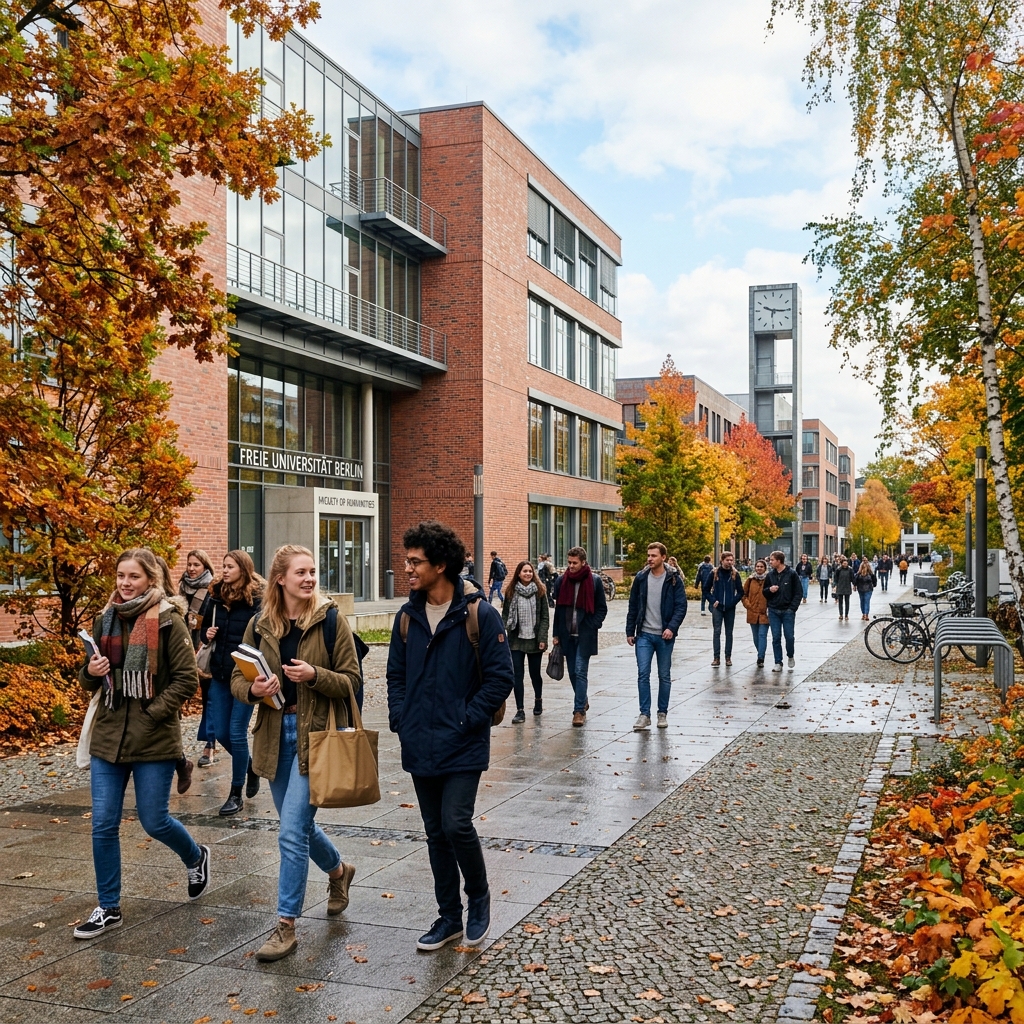
If you've spent any time researching study abroad options in Germany, you've probably come across the Free University of Berlin more than once. It's one of the country's biggest and most well known research universities, and for a lot of international students, it ends up on the shortlist simply because Berlin itself is such a magnetic city to live in for a few years.
Here's a more grounded look at what the university actually offers, what it costs, and what life around it looks like.
Where the Name Actually Comes From
The "Free" in Free University of Berlin isn't a hint that classes cost nothing, even though tuition being minimal is a nice bonus that comes along with it. The name goes back to the university's founding in December 1948, and the story behind it is genuinely interesting rather than just a footnote.
After the Second World War, Berlin's original university, on Unter den Linden, ended up in the Soviet occupied sector and came under the Central Administration for Popular Education. Over the following two years, students and professors who pushed back against the growing communist influence on academic life found themselves in increasing conflict with the authorities.
Several student representatives were arrested, and in April 1948 three students were expelled from the university for publishing critical pieces in a student magazine.
That expulsion set off a wave of protest, and out of it, with support from American occupation authorities and West Berlin's own politicians, a group of professors and students broke away and founded a new university in the American sector of the divided city.
That new institution became the Free University of Berlin, and its motto ever since has been Veritas, Iustitia, Libertas, truth, justice, freedom. So the name is really about academic independence from political interference, not about fees.
Is It Actually Tuition Free
Mostly, yes. Freie Universität Berlin does not charge tuition fees for the vast majority of its degree programs, for both German and international students, with continuing education and a handful of specialised executive style master's programs being the exception.
What every enrolled student does pay is a semester contribution, sometimes called a semester fee, and it's worth being upfront that this isn't a token amount.
Depending on the semester, it typically lands somewhere around 300 euros, give or take, and it covers things like administrative costs, a contribution to the Studierendenwerk (the student services body), a student government fee, and importantly, a semester ticket that gives you unlimited public transport across Berlin for the whole term.
So while it's nowhere close to actual tuition, don't go in expecting the fee to be pocket change either. Always check the university's own fee page before you budget, since the exact figure is revised periodically.
What You Can Actually Study There
The range of programs is genuinely wide. You'll find strong offerings across the humanities, social sciences, natural sciences, and business related fields, at both undergraduate and postgraduate level.
The university has a particularly strong reputation in political science, sociology, and history, which makes sense given its own origin story is so tied up in political history.
A good number of master's programs, especially, are taught fully in English, though most bachelor's programs still lean heavily on German, so it's worth checking the language of instruction carefully for whatever specific program you're eyeing.
A Genuinely International Campus
People from more than 150 countries study and work at Freie Universität, which is a lot for a single university, and it shows in daily campus life.
You end up surrounded by classmates from very different backgrounds, and a fair number of faculty members are international as well, which brings a different flavor to how courses get taught compared to a purely domestic institution.
Applying: What to Actually Expect
Eligibility depends heavily on the specific program, but generally you'll need proof of your previous academic qualifications, language proficiency in German or English depending on the course, and the usual set of supporting documents.
Deadlines genuinely vary by program and by intake, undergraduate admissions for a winter semester start typically open in early summer, but master's deadlines are all over the place depending on the department, so treat the official program page as the only source you fully trust here rather than a generic timeline.
International applicants also often go through uni-assist for the initial document check before the university's own admission process even begins, so build that extra step into your planning.
If your German isn't strong and your chosen program leans on it, it's worth looking into a preparatory language course either before you start or during your first semester, rather than assuming you'll pick it up as you go.
Living in Berlin as a Student
This is honestly one of the bigger draws. Berlin is noticeably more affordable than cities like London or Paris, and shared flats are the norm among students rather than the exception. Student discounts stretch a long way here too, on everything from museum entry to food.
Outside the classroom, the city doesn't really slow down. There's a constant rotation of cultural events, and the university itself runs workshops, lectures, and social gatherings that make it easier to actually meet people rather than just attend classes and go home.
On campus, you get access to solid libraries and research facilities, whether you want a quiet corner to work alone or a room to collaborate with a group.
Berlin Outside the University
You don't need to leave campus far to run into history. The Brandenburg Gate and the remaining sections of the Berlin Wall are both accessible, and the city's museums and galleries do a genuinely good job of contextualising its complicated twentieth century past.
If you'd rather spend your downtime somewhere green, Tiergarten, Tempelhofer Feld, and Volkspark Friedrichshain are all solid options for a picnic or just getting away from your desk for an afternoon.
Career Side of Things
Freie Universität maintains real ties with industry, and internships, career fairs, and workshops come up regularly enough that building a professional network before graduation is genuinely achievable, not just a line in a prospectus.
The university's alumni network is also large enough to be useful, and tapping into it for mentorship or introductions is a reasonably common thing for current students to do.
Exchange and Short Term Options
If a full degree isn't what you're after, Freie Universität runs exchange programs with partner institutions around the world, along with shorter study programs aimed at students who want a semester or so of immersion and credits to bring back to their home university. Both are worth looking at if you're not ready to commit to a multi year degree abroad.
Things Worth Being Honest About
Daily life outside the classroom will still involve some German, even if your coursework is entirely in English, so picking up at least the basics makes a noticeable difference in how smoothly things go, from dealing with paperwork to just chatting with neighbours. And moving somewhere new is genuinely disorienting for most people at first.
Joining a student group or cultural organisation early tends to make that adjustment period a lot shorter than trying to muscle through it alone.
Where to Verify the Details Yourself
Fees, deadlines, and program specifics change often enough that it's worth going straight to the source before you plan around anything you read here or anywhere else online.
- Freie Universität Berlin, Official Website
- Fees and Dues
- About Freie Universität, Founding History
- uni-assist, International Application Service
- DAAD, Scholarships for International Students in Germany
The Free University of Berlin isn't free in the way people sometimes assume from the name, but between the low cost of actually studying there and the sheer amount going on in the city around it, it's easy to see why so many international students end up choosing it over places with far higher price tags attached.
Get personalized study abroad advice
Chat with our AI advisor about this article - tailored to your profile.
Start conversation